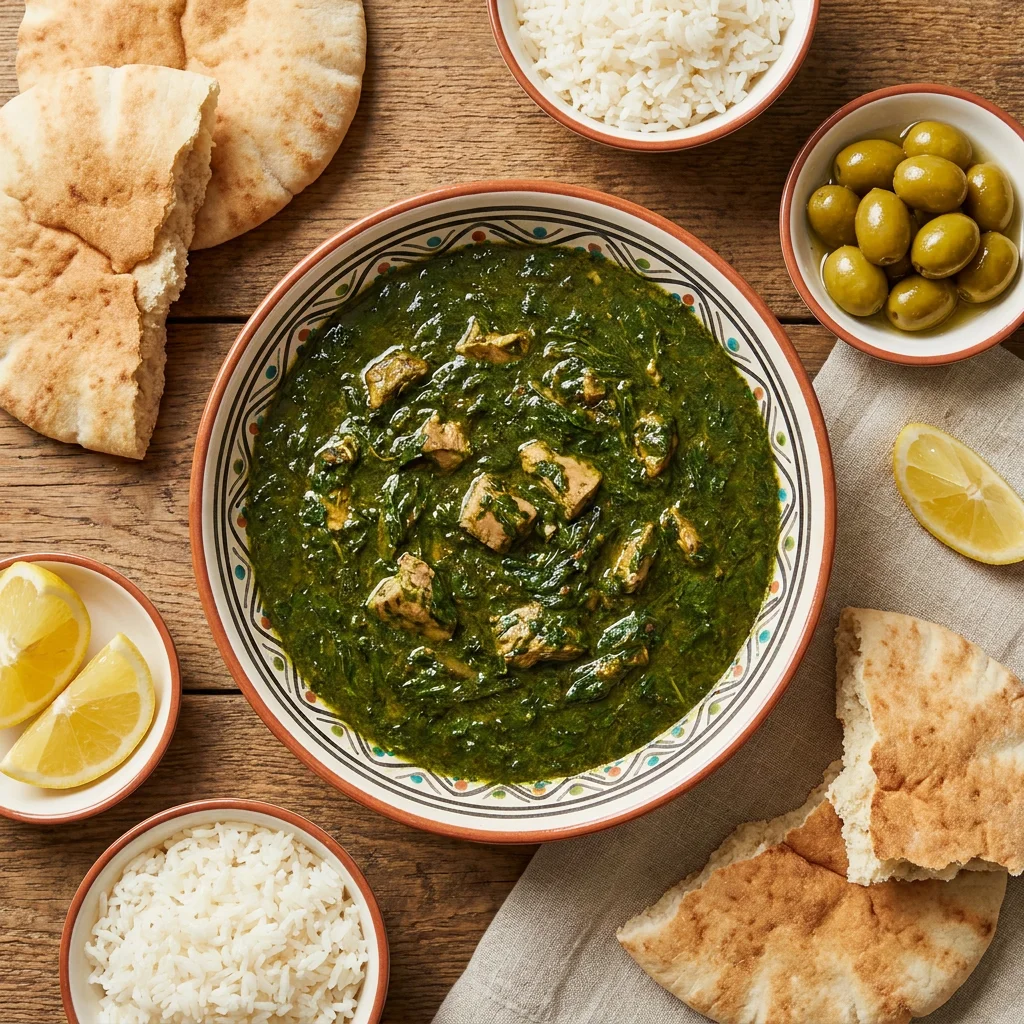
One of the Oldest Dishes Still on the Table
Mulukhia takes its name from the jute plant — Corchorus olitorius — whose large, serrated leaves have been eaten in the Middle East and North Africa for thousands of years. The plant grows tall on long stems, and its leaves resemble an oversized mint leaf, though the flavor is entirely its own: earthy, slightly viscous when cooked, deeply savory.
It is believed to have originated in ancient Egypt, where it remains the fourth most popular dish in the country after koshary, ful medames, and ta’ameya. But the Levantine version — fragrant with allspice, cardamom, and a finishing bloom of golden garlic and coriander — has its own distinct character and has been made in Palestinian and Lebanese homes for just as long.
🌿 The defining moment of this recipe is the garlic and coriander bloom — fried until just golden, then poured sizzling into the mulukhia pot. Don’t rush it and don’t let the garlic burn. That step is what makes the dish.
About Mulukhia
- 🌱 The plant: Jute mallow (Corchorus olitorius), also called Jews mallow. Its stems grow tall and its leaves resemble large mint leaves — but taste nothing like mint.
- 🏺 Ancient origins: Believed to originate in ancient Egypt, where it remains one of the most beloved national dishes to this day.
- 🌍 Widespread love: Eaten across Egypt, Palestine, Lebanon, Jordan, Tunisia, and as far as West Africa — each region with its own variation.
- 🧄 The finishing touch: The garlic and coriander bloom — ta’lia in Arabic — is what defines the Levantine version and sets it apart from the Egyptian preparation.
The Story
There are dishes that belong to a particular family or region, and then there are dishes that belong to an entire civilization. Mulukhia is the latter. For thousands of years, from the banks of the Nile to the hills of the Galilee, families have been simmering these dark green leaves into a stew that is at once humble and deeply nourishing — the kind of dish that appears on the table every week, that children grow up eating, and that adults miss desperately when they are far from home.
The jute plant itself is extraordinary. It grows quickly and abundantly in warm climates, which is part of why it became a staple food across such a wide geography. In Egypt it is sometimes left whole; in the Levant it is typically chopped fine. The cooking method varies too — some families use lamb, others rabbit, others chicken — but the soul of the dish remains the same: a rich broth, dark and slightly viscous leaves, and always, at the end, that sizzling pour of golden garlic and coriander that fills the kitchen with an aroma like no other.
“The garlic bloom — poured sizzling into the pot at the very end — is the moment mulukhia becomes mulukhia. Everything else is preparation.”
In the Western world, fresh jute leaves are nearly impossible to find outside of specialist growers. But frozen mulukhia — widely available in the freezer sections of Mediterranean and South Asian grocers — works beautifully in this recipe. The flavor holds up well to freezing, and the convenience means you can make mulukhia any time of year, not just when the plant is in season.
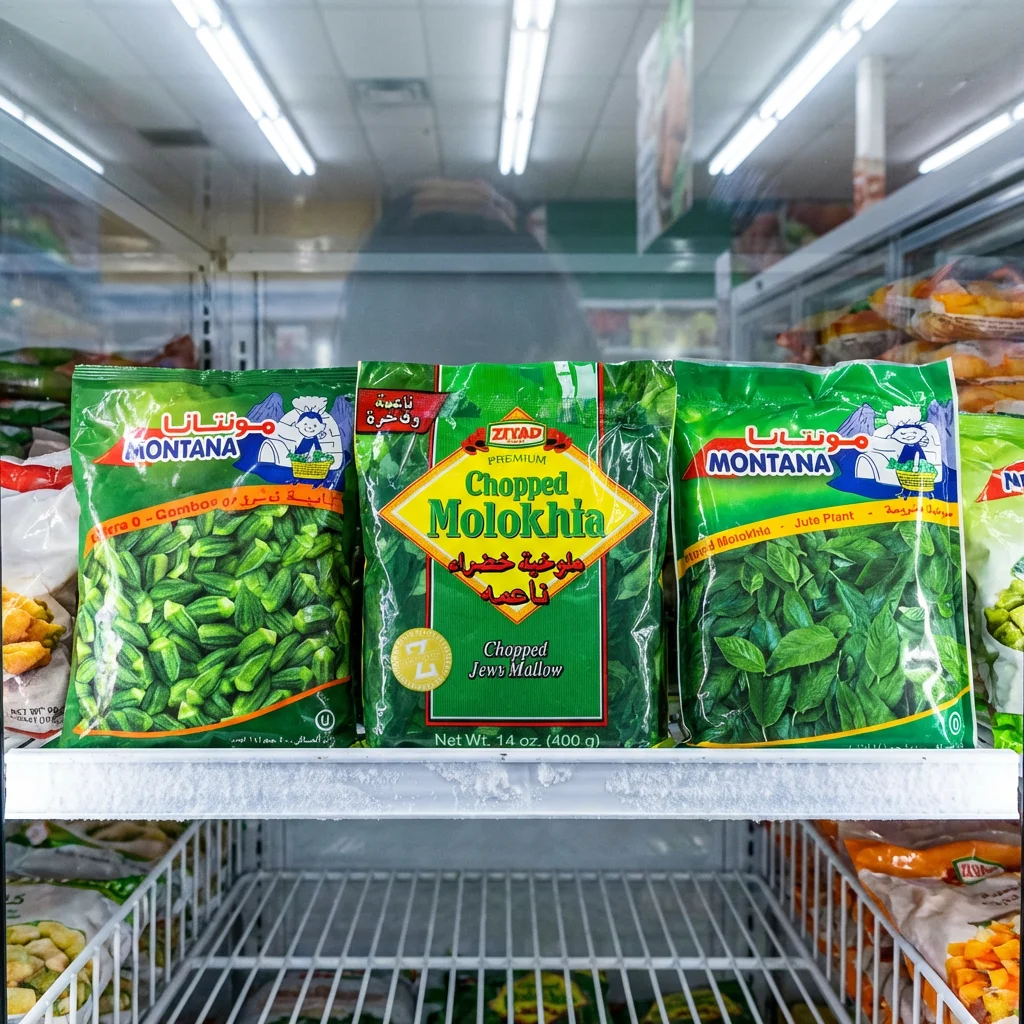
This recipe uses a whole chicken to build the broth — the foundation everything else is built on. Take the time to skim the foam carefully during the first cook; a clean, fragrant broth makes a noticeable difference in the finished stew. The chicken is then shredded and returned to the mulukhia, making this a complete, generous meal in a single pot.
Variations
Mulukhia varies significantly across the region. Here are a few adjustments worth knowing.
- Diced tomatoes — Add to the stew in the final simmer for a slightly brighter, more acidic flavor. Common in some Palestinian and Lebanese households.
- Lamb instead of chicken — Use bone-in lamb shoulder pieces to build the broth for a richer, more intense stew. Particularly common in Jordan and among Palestinian families from the Hebron area.
- Rabbit — The traditional Egyptian preparation often uses rabbit rather than chicken, which gives the broth a distinctly gamier, more complex base.
- Whole leaves vs. chopped — The frozen packages typically contain finely chopped mulukhia, which gives a silkier, more uniform texture. If you can find whole frozen leaves, they produce a more rustic, textured stew.
- Fresh mulukhia — If you are lucky enough to find fresh jute leaves at a farmers market or specialty grower, use 8 cups of loosely packed leaves, stripped from the stems, washed, and finely chopped before cooking.
How to Make It
Build the Chicken Broth
Place the quartered chicken and onion in a large, deep pot. Add the allspice, bay leaves, cardamom pods, nutmeg, black pepper, and salt. Pour in 8 cups of water and bring to a boil over high heat. Reduce to a steady simmer and cook for 45–60 minutes, skimming and discarding any foam that rises to the surface — repeat this several times. The broth should be clean and fragrant when done. Remove the chicken and set aside to cool.
Cook the Mulukhia
Place the frozen mulukhia leaves in a separate pot over medium heat and sauté until fully thawed. Strain 4 cups of the chicken broth and add it to the mulukhia along with the crushed bouillon cube. Stir to combine and bring to a gentle simmer. Cook for 20 minutes. While the mulukhia simmers, shred the cooled chicken meat by hand into small pieces, discarding the skin and bones.
Make the Garlic Bloom
In a small pan over medium heat, warm the olive oil or ghee. Add the crushed garlic and fry, stirring frequently, until it turns a deep golden color — watch it carefully, as the line between golden and burnt is narrow. Add the ground coriander and stir for another 30 seconds until fragrant. The mixture should be sizzling and aromatic.
Finish the Stew
Pour the entire garlic and coriander mixture directly into the mulukhia pot — it should sizzle on contact. Add the shredded chicken and stir everything together. Simmer for a further 15 minutes to let the flavors meld. Taste and adjust salt as needed. If you prefer a thinner stew, add more strained broth at this stage a ladle at a time until you reach your preferred consistency.
Serve
Ladle the mulukhia into deep bowls and finish each serving with a generous squeeze of fresh lemon juice at the table. Serve alongside a white rice-and-vermicelli pilaf and warm pita bread. The lemon is not optional — it cuts through the richness of the stew and brightens the whole dish.